
Robinhood has made stock market access easier for millions of retail investors. With a few taps, users can buy stocks, ETFs, options, ADRs, and other supported securities. Robinhood brokerage platform supports more than 11 thousands of securities, including most U.S. stocks and ETFs, many closed-end funds, options on U.S.-listed stocks and ETFs, ADRs for many global companies, and certain OTC equities. Although, it does not support every asset type, including mutual funds, direct bond trading, many foreign-exchange-listed stocks, and some other specialized securities.
That accessibility is powerful, but it also creates a challenge. When investing feels easy, research can become optional. A ticker starts trending, a chart looks exciting, a headline goes viral, and suddenly a trade is placed before the investor has answered the most important question: Why do I want to own this?
That is where a structured research workflow matters. Robinhood can be the place where you execute an investment decision. But Investorean can be the place where you prepare that decision.
Investorean is an analytics and media platform built for market research, investing education, portfolio tools, investing ideas, and broker-connected screening. It’s an all-in-one analytics and media platform for market research, education, and entertainment, with broker syncing designed to help investors focus on assets available through their broker.
Here is a practical framework for using Robinhood more thoughtfully, with Investorean as your research layer.
1. Start With a Plan Before Opening the Trading Screen
A common mistake among new investors is starting with the stock instead of the strategy. Before buying anything on Robinhood, define the basics:
- Your goal: Are you investing for long-term wealth, income, short-term trading, or learning?
- Your time horizon: Are you planning to hold for weeks, months, or years?
- Your risk limit: How much could this position fall before it would meaningfully hurt your portfolio or your decision-making?
- Your thesis: What has to be true for this investment to work?
Asset allocation normally depends heavily on an investor’s time horizon and ability to tolerate risk. In plain English: a 25-year-old investing monthly for retirement should usually think differently from someone trading short-term earnings reactions. This is the first role Investorean can play. Instead of opening Robinhood and reacting to what is moving today, investors can use Investorean to filter, compare, and study opportunities first. Robinhood makes investing accessible, and Investorean helps make the process more deliberate.
2. Know What You Can Actually Trade on Robinhood
Every broker has a different investment universe. Robinhood supports many popular U.S.-listed securities, but not everything. For example, Robinhood says it supports U.S. exchange-listed stocks, ETFs, CEFs, options contracts on supported U.S.-listed stocks and ETFs, ADRs for many globally listed companies, certain warrants, certain preferreds, and certain OTC equities. But it does not support assets such as mutual funds, direct bond and fixed-income trading, many foreign-domiciled stocks, limited partnerships, royalty trusts, and several other categories. And this matters because an investor may research an international stock, niche fund, or income product only to discover that it is not available through their brokerage account.
Investorean is especially useful here because it is designed to connect research with broker availability. It integrates with multiple brokerages, including Robinhood, eToro, and Interactive Brokers, so users can research assets that are available through their selected broker. For Robinhood users, that can reduce wasted time. Rather than building a watchlist full of assets you cannot trade, you can focus your research on the universe that is actually actionable.
3. Use Screeners Instead of Chasing Headlines
Headlines are not a strategy. Social media is not a due diligence process. A stock going up today does not automatically make it a good investment tomorrow.
A better approach is to begin with a screen. For example, a long-term investor might screen for:
- Companies with consistent revenue growth
- Positive earnings
- Reasonable valuation metrics
- Manageable debt
- Strong dividend history
- Sector or industry leadership
- A swing trader might care more about:
- Relative strength
- Volume trends
- Moving averages
- Breakouts or pullbacks
- Volatility
- Support and resistance levels
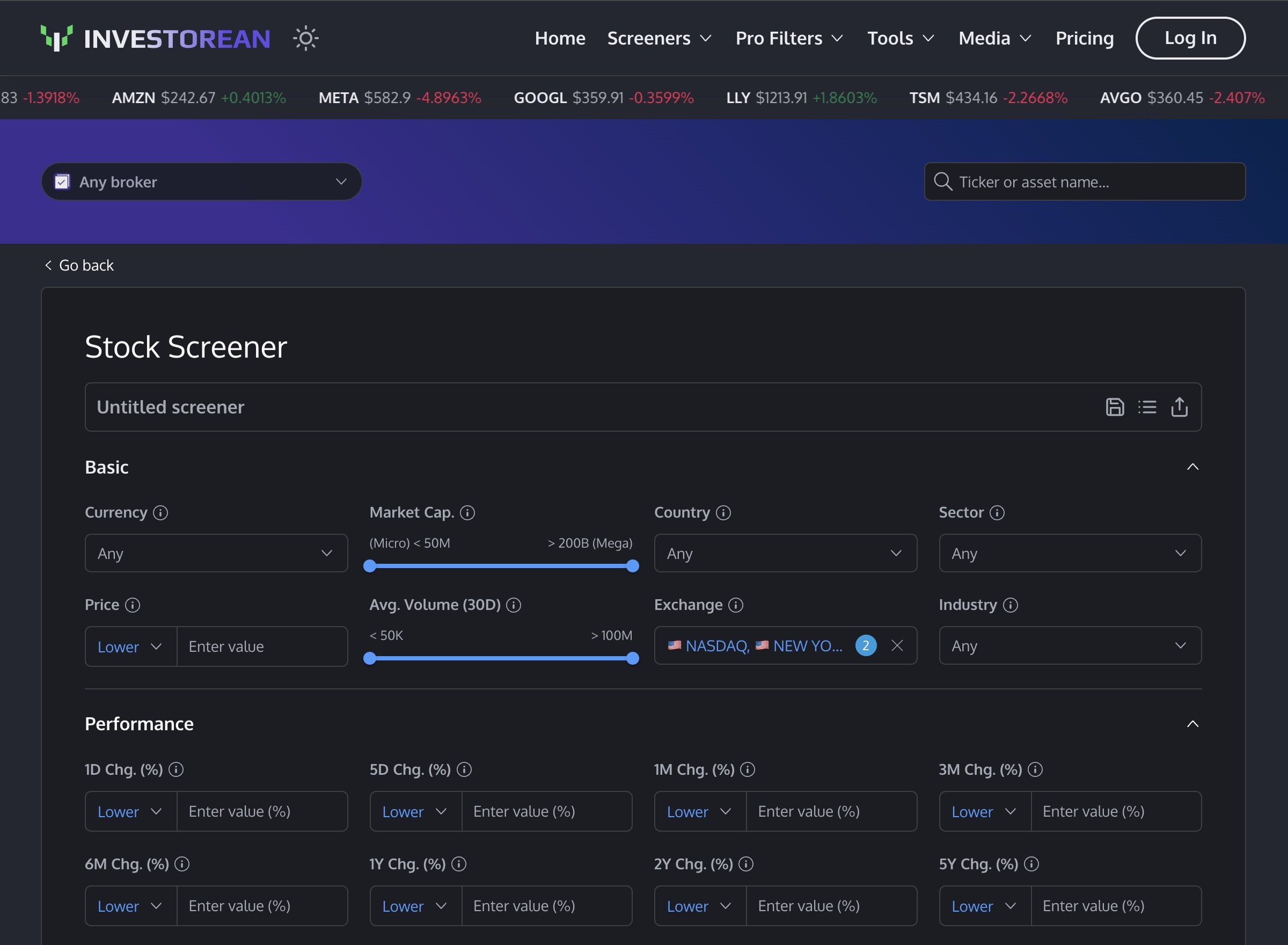
Investorean provides an economic calendar, latest news, and access to a broad market universe that includes stocks, indices, ETFs, and currencies. The advantage of a screener is that it flips the process. Instead of asking, “Should I buy this stock I just heard about?” you ask, “Which stocks currently match the conditions I care about?”
That is a healthier starting point for Robinhood investors because it slows down impulsive decision-making.
4. Build a Simple Research Checklist
Before buying a stock on Robinhood, run it through a repeatable checklist. The checklist does not need to be complicated. It just needs to be consistent.
Here is a practical example:
- Business quality: What does the company do, and how does it make money?
- Financial health: Is revenue growing? Is the company profitable? Is debt manageable?
- Valuation: Is the stock expensive or cheap compared with its own history, peers, or growth rate?
- Momentum: Is the stock trending up, down, or sideways?
- Catalysts: Are earnings, product launches, economic data, regulatory events, or sector trends likely to affect the stock?
- Risk: What would make the investment thesis wrong?
- Position size: How much of your portfolio should this idea represent?
- Investorean can help centralize much of this research. Its guides describe using screeners, fundamental analysis, technical indicators, market news, and portfolio monitoring as part of a structured analysis process.
The goal is not to predict the future perfectly. No tool can do that. The goal is to make sure every trade has a reason, a risk plan, and a place in your broader portfolio.
5. Understand Order Types Before You Trade
Once you decide to place a trade on Robinhood, order type matters. Market orders are designed to execute immediately, but they do not guarantee the execution price. Limit orders specify a price or better, but they may not execute. Stop orders become market orders once the stop price is reached.
For long-term investors buying highly liquid stocks during regular market hours, a market order may be acceptable in some cases. But for volatile stocks, thinly traded securities, extended-hours trading, or fast-moving markets, limit orders can help investors control the maximum price they are willing to pay or the minimum price they are willing to accept.
Robinhood also offers extended-hours trading. Traditional U.S. market hours are 9:30 a.m. to 4:00 p.m. ET; Robinhood lists extended hours as 7:00 a.m. to 9:30 a.m. ET and 4:00 p.m. to 8:00 p.m. ET, and it also notes that select stocks and ETFs may trade through its 24 Hour Market. However, market orders are not supported during extended or overnight sessions and that investors should consider additional risks.
The lesson: your research process does not end when you choose a ticker. Execution is part of risk management.
6. Be Careful With Margin and Frequent Trading
Robinhood’s simplicity can make active trading feel effortless. But frequent trading, margin use, and short-term speculation can increase risk quickly.
A major recent change is that FINRA’s new intraday margin standards replaced the old Pattern Day Trading framework on June 4, 2026. Robinhood says that, starting then, there are no more day trade restrictions or day trade calls for Robinhood margin accounts, and the $25,000 minimum portfolio value requirement to day trade in a margin account no longer applies. However, the $2,000 margin minimum equity requirement still applies and that accounts are monitored in real time for intraday margin deficits. This is important for Robinhood investors: fewer restrictions do not mean lower risk. They simply mean investors need stronger personal rules.
Before trading frequently, define:
- How many trades you will take per week
- How much capital you will risk per trade
- Whether you are using cash or margin
- What conditions must exist before entering
- When you will exit if wrong
- When you will take profits if right
Investorean’s portfolio tools and screening workflow can support this discipline by helping investors review performance, compare positions, follow news, and evaluate setups before acting. Investorean portfolio tracker is a tool for performance snapshots, position comparison across time ranges, portfolio-related news, price chart comparison, and manual or broker-export-based portfolio import.
The best investors do not just track what they own. They track why they own it.
7. Diversify Instead of Betting Everything on One Idea
Even a strong investment thesis can fail. A great company can report weak earnings. A promising sector can fall out of favor. A high-quality stock can become overpriced. That is why diversification matters. Asset allocation, diversification, and rebalancing are important tools for managing investment risk. Diversification means spreading investments both among and within asset classes, while rebalancing means making periodic adjustments to stay aligned with a target allocation.
For Robinhood users, diversification can be as simple as avoiding a portfolio that depends entirely on one stock, one sector, one theme, or one short-term market narrative. A practical portfolio review might ask:
- Am I too concentrated in technology?
- Do I own only growth stocks?
- Do I have any dividend or defensive exposure?
- Am I overexposed to one company’s earnings report?
- Do I have too much cash, or too little?
- Does this portfolio still match my original plan?
Robinhood provides account activity reports and statements, including downloadable CSV activity reports for brokerage and retirement accounts. Combined with Investorean’s portfolio tracker and import capabilities, that can help investors review their actual behavior, not just their intended strategy. And that distinction matters. Your transaction history often reveals whether you are investing with discipline or reacting emotionally.
8. Separate Research, Execution, and Review
A strong Robinhood workflow can be broken into three stages:
- Research in Investorean. Use screeners, market news, fundamentals, technical indicators, economic calendars, and portfolio tools to identify and evaluate opportunities.
- Execute in Robinhood. Place the trade only after defining the thesis, order type, position size, and exit plan.
- Review back in Investorean. Monitor performance, compare positions, track news, and decide whether your original thesis still holds.
This separation helps reduce impulsive trading. Robinhood is excellent for access and execution. But the most important investing decisions should happen before the order screen.
9. A Sample Workflow for a Robinhood Stock Investor
Here is what a practical weekly routine could look like:
Monday: Market scan
Use Investorean to review broad market conditions, economic events, and sector trends. Check whether any major earnings, inflation data, Federal Reserve events, or geopolitical developments may affect your watchlist.
Tuesday: Idea generation
Run a stock screener based on your strategy. A dividend investor might screen for dividend growth and financial stability. A growth investor might screen for revenue growth and improving margins. A swing trader might screen for momentum and technical setups.
Wednesday: Deep research
Pick three to five candidates. Review fundamentals, valuation, chart structure, recent news, and risk factors. Remove anything you do not understand.
Thursday: Portfolio fit
Ask whether the new idea improves your portfolio or simply duplicates exposure you already have. Check concentration by stock, sector, and strategy.
Friday: Decision and journal
Decide whether to buy, wait, or pass. If you buy on Robinhood, record the thesis, entry price, position size, and what would make you sell.
This routine is not exciting, and that is the point. Good investing is usually less about excitement and more about repeatable decision-making.
10. Robinhood Is the Door. Investorean Is the Research Desk.
Robinhood lowered the barrier to market participation. That is a major benefit for retail investors. But access alone is not an investing strategy. A better approach is to combine Robinhood’s ease of execution with a disciplined research process. Investorean gives investors a place to screen assets, analyze markets, follow news, monitor portfolios, and connect research with broker availability. For Robinhood users, that can mean fewer random trades and more informed decisions.
The stock market rewards patience, preparation, and risk management more often than impulse. Before tapping “Buy,” take a step back. Build the thesis. Check the data. Review the risk. Understand the order type. Know how the position fits your portfolio.
Robinhood can help you act. Investorean can help you think before you act.
Disclaimer: This article is for educational purposes only and is not financial, investment, tax, or legal advice. Investing involves risk, including possible loss of principal. Always do your own research and consider speaking with a qualified financial professional before making investment decisions.