
Walk through any downtown district after dark and you’ll notice something that wasn’t there a few years ago. Logos glow on brick walls. Restaurant names hover above sidewalks like holograms. Real estate signs appear on empty storefronts, announcing a grand opening without a single nail or screw involved. None of it involves paint, banners, or a construction crew. It’s light, shaped and aimed with startling precision, and it’s quietly becoming one of the most cost-effective advertising tools available to small businesses and event planners alike.
That shift didn’t happen because signage got cheaper. It happened because a small, specialized category of hardware finally caught up with what marketers have wanted for years: a way to put a brand in front of people without committing to a permanent structure.
What a Gobo Projector Actually Does
The word gobo is a holdover from theater and film lighting, generally understood as shorthand for go before optics, a physical or digital template placed in front of a light source to shape the beam into a specific image. Unlike a traditional projector, this kind of fixture doesn’t need a blank screen or a darkened room to work. It throws a sharp, high-contrast image onto almost any surface: brick, concrete, glass, even a wet parking lot. Point one at the side of a building, and within seconds a logo appears that’s visible from a block away, with no cables running across the sidewalk and no bulky screen to set up and tear down every night.
That simplicity is exactly why these fixtures have moved out of theater rigs and nightclubs and into the toolkit of restaurants, retail chains, and wedding planners. A single unit mounted once can run every evening on a timer, turning a plain exterior wall into rotating real estate for a brand.
Why Marketers Can’t Stop Talking About Them
Traditional signage has a shelf life. Banners fade, vinyl decals peel, and neon requires an electrician on speed dial. A projected image, by contrast, can be swapped in minutes just by changing the gobo disc or, on newer models, loading a new file. That flexibility is a big part of the appeal: a coffee shop can advertise a seasonal drink one week and a holiday promotion the next, without paying a sign shop for a new install every time the message changes.
There’s also a novelty factor that’s hard to manufacture with a static sign. People stop and photograph a projected logo far more often than they photograph a printed banner, and that kind of organic sharing is difficult to buy at any price. Event planners lean on the same principle, projecting a monogram onto a reception hall floor or a company emblem above a conference entrance. It reads as premium production value, even though the hardware involved is compact enough to sit on a tripod in the corner of a room.
Built for the Elements: Indoor Comfort Meets Outdoor Grit
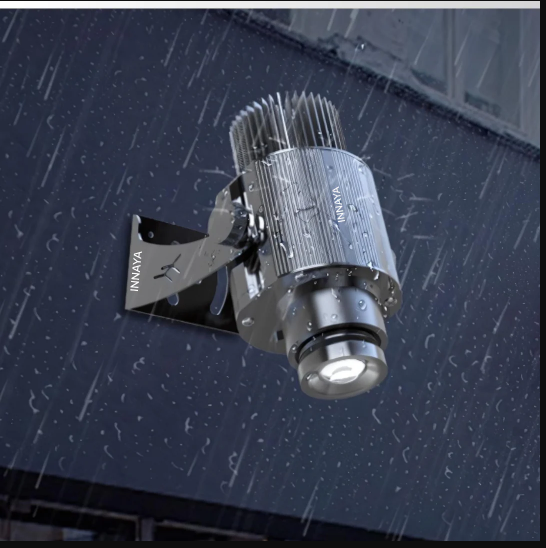
Not every unit on the market is built the same way, and this is where buyers run into trouble. A fixture designed for a quiet indoor stage won’t survive a rainy parking lot, and a unit rated only for casual indoor use will wash out completely under direct sunlight or across any real distance. The better outdoor-rated gobo projectors solve both problems at once: sealed, weatherproof housings that shrug off rain and temperature swings, paired with enough lumen output and lensing to throw a crisp image thirty, fifty, even a hundred feet without turning into a blur.
Power draw matters just as much. Lower-wattage units are fine for a shop window or an indoor lobby, while higher-wattage models are built for throwing a logo across a parking lot or onto the face of a multi-story building. Offering the same fixture in more than one wattage configuration means a buyer isn’t stuck overpaying for power they don’t need, or underpowering a job that actually requires real distance and brightness.
Choosing the Right Projector for Your Brand
Before buying, it helps to answer three questions honestly: how far does the image need to travel, how bright is the surrounding environment, and will the unit live outdoors permanently or get carried between events. A fixture that performs beautifully on a dim, covered patio might struggle badly on an open sidewalk under streetlights. Distance and lumen output should be matched to the actual space, not just the marketing copy on a box.
It’s also worth checking how easy a unit is to aim and refocus. Some fixtures require full disassembly just to adjust the angle, which gets tedious fast if the projector needs to be repositioned for different events. Retailers that specialize specifically in this category, rather than treating it as an afterthought bolted onto a general lighting catalog, tend to get these small details right. That focus is part of why a dedicated retailer like Innaya Store has built a following among small business owners: the catalog stays narrow enough that every listing is actually built for logo and advertising projection, rather than repurposed stage lighting with a gobo slot added as an afterthought.
What It Actually Costs to Get Noticed
Run the numbers and the appeal becomes obvious. A custom illuminated sign, complete with a permit, an electrician, and an installation crew, commonly starts well north of a thousand dollars before a single bulb switches on, and that figure doesn’t include maintenance or eventual replacement. A single logo projector, by comparison, plugs into a standard outlet, mounts on an existing wall or post, and can be repositioned or swapped out entirely in an afternoon. For a seasonal pop-up, a food truck, or a small storefront testing a new location, that difference matters. It’s the gap between committing thousands of dollars to a fixed sign and spending a few hundred on a fixture that can move with the business.
The Simple Mistakes That Sink a Great Projection
Even good hardware can look cheap if it’s set up carelessly. The most common mistake is projecting onto a surface with too much texture or color variation, brick with heavy mortar lines or a wall covered in ivy will blur even the sharpest image. Smooth, relatively uniform surfaces in mid-tone colors read the cleanest. The second mistake is underestimating ambient light. A projector that looks brilliant in a demo video shot at midnight can nearly disappear when aimed at a wall lit by a streetlamp or a storefront floodlight.
Finally, plenty of buyers skip the weatherproofing specs entirely and end up replacing a unit within a season because condensation worked its way into the housing. None of these are hard problems to avoid, they just require matching the fixture to the job before checkout instead of after installation.
The Bottom Line
Static signage isn’t going anywhere, but it’s no longer the only affordable option for a business that wants its name seen after the sun goes down. A well-placed beam of light, chosen with the right brightness, distance, and weatherproofing for its environment, can do the same job as an illuminated sign at a fraction of the installation cost and with far more flexibility. Anyone shopping this category for the first time will find that the fixtures pairing real lumen output with a genuinely sealed housing, rather than one or the other, are the ones that end up mounted for years instead of returned after a single rainy weekend.