
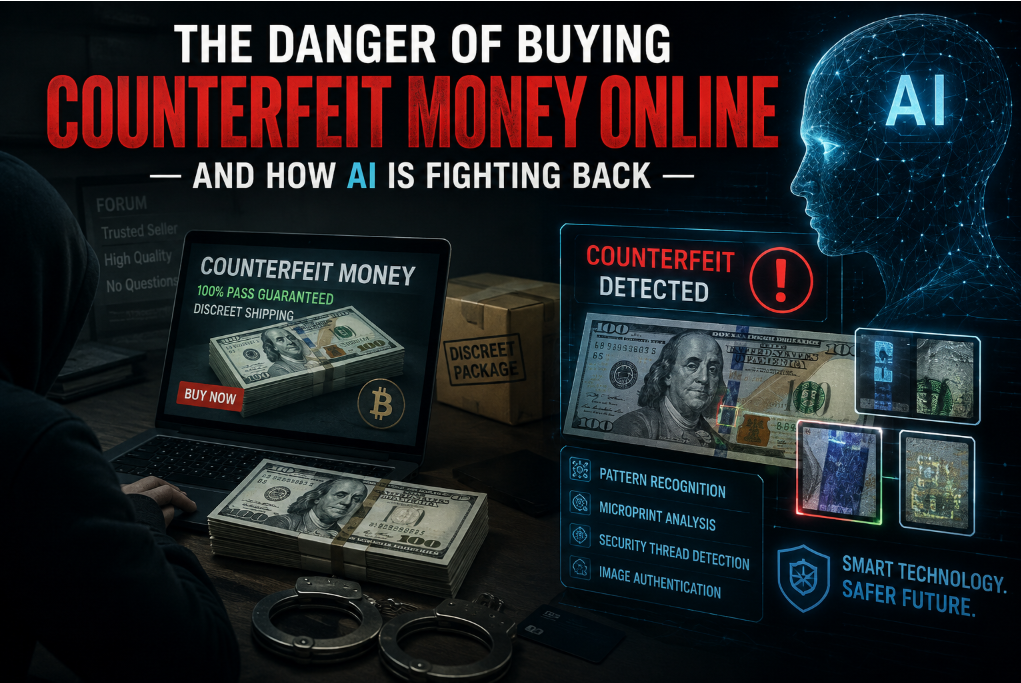
A quick search on the open web or a scroll through certain corners of social media and encrypted messaging apps will turn up something that sounds almost too good to be true: sellers offering “high-quality replica” banknotes, “prop money that passes the pen test,” or discounted bundles of “undetectable” bills, shipped discreetly to your door. For a fraction of the face value, buyers are promised cash that looks, feels, and even scans like the real thing.
It isn’t a good deal. It’s a trap — legally, financially, and often physically. Below is a look at why buying counterfeit currency online is far riskier than it appears, and how artificial intelligence is increasingly the tool standing between counterfeiters and the rest of us.
Why People Are Tempted
The pitch is simple: pay $200 for $1,000 in “premium” fake bills, guaranteed to pass UV light, pens, and even ATMs. Marketplaces on the dark web and, increasingly, thinly-veiled listings on mainstream platforms lean on urgency and secrecy — limited stock, encrypted chat only, cryptocurrency payment required. For someone in financial distress, or simply curious about how far the “no risk, no scam” claims can be trusted, it can look like an easy shortcut.
It’s worth being blunt about this up front: none of it is worth pursuing. There is no version of this transaction that ends well for the buyer.
The Real Risks of Buying Counterfeit Money Online
1. It’s a federal crime, not a gray area. In the United States, manufacturing, possessing, or passing counterfeit currency violates federal law, and penalties can include up to 20 years in prison plus significant fines. Simply having counterfeit bills in your possession — even if you never spend a single one — can be enough to trigger charges. Ignorance is not typically a viable defense once a pattern of large or repeated “purchases” is established, because prosecutors can argue the buyer should reasonably have known real currency isn’t sold online at a discount.
2. You’re very likely being scammed twice. Most people who “buy” counterfeit money online never receive anything at all. Sellers collect payment — usually in cryptocurrency, which is difficult to trace or reverse — and simply disappear. The Federal Trade Commission and consumer-protection researchers have repeatedly flagged counterfeit-currency listings as a common vector for straightforward payment fraud, layered on top of the underlying illegality of the “product” itself.
3. The money itself is worthless and dangerous to hold. Even in the rare case a buyer receives something resembling banknotes, spending it is a separate crime (uttering counterfeit currency), and getting caught with it — at a store, a bank, or in a routine stop — creates an evidence trail: shipping records, chat logs, payment metadata. Law enforcement agencies, including the U.S. Secret Service (which has jurisdiction over counterfeit currency investigations), routinely trace these transactions back to buyers, not just sellers.
4. It funds organized crime. Large-scale counterfeiting operations are rarely amateur hobbyists. Profits from counterfeit currency sales frequently flow into broader criminal networks involved in drug trafficking, money laundering, and other organized crime, meaning a “cheap cash” purchase can indirectly bankroll much more serious harm.
5. Modern fakes are getting harder to spot — and more dangerous to hold unknowingly. As AI-powered image generation and design tools become more accessible, counterfeiters can study genuine banknotes closely and reproduce fine details like color gradients and micro-patterns with far fewer errors than in the past. That means bills that once would have failed a basic visual check now have a better chance of slipping past a distracted cashier, raising the odds that even someone who receives counterfeit bills unknowingly — say, as change, not from a shady online deal — ends up holding worthless currency and taking the financial loss themselves.
Where AI Fits Into the Story — On Both Sides
Artificial intelligence cuts both ways in this fight, and it’s worth understanding both.
AI as a tool for counterfeiters. Generative AI and advanced image-editing tools have lowered the skill floor needed to replicate visual security features — fine-line guilloché patterns, color-shifting ink effects, and layout details — making some counterfeit notes harder to catch with the naked eye than in previous years. This is a genuine and growing concern flagged by fraud-detection researchers, who note that AI is reshaping not just how fake currency is produced but how it’s distributed and concealed.
AI as the primary defense. On the detection side, machine learning has become the backbone of modern anti-counterfeiting technology, and the shift has accelerated quickly. Rather than relying purely on a single UV light or magnetic-ink sensor, current systems increasingly combine multiple signals — magnetic, infrared, and watermark detection — and feed them into machine-learning models trained to recognize the subtle statistical fingerprint of a genuine note.
A few concrete ways AI is being deployed:
- Convolutional neural networks (CNNs) for image-based verification. Researchers have trained deep learning models on large datasets of genuine and counterfeit banknote images so that a smartphone or scanner camera can flag a fake note in real time, often achieving accuracy rates well above 95% in controlled testing. These models learn to spot inconsistencies in printing texture, ink density, and micro-patterning that are effectively invisible to a human eye doing a quick check.
- Hybrid AI systems. Some of the newer detection approaches combine generative adversarial networks (GANs) — the same underlying technology counterfeiters exploit — with classification models, essentially using AI to simulate and anticipate new counterfeiting techniques before they show up in circulation, then training detectors to catch them.
- Next-generation hardware. Currency-counting and verification machines used by banks and retailers are increasingly built around neural-network scanners capable of catching “micro-inconsistencies” in ink alignment and density that older sensor-only systems would miss entirely. Analysts tracking the counterfeit-detection market expect this AI-enabled hardware to become mainstream in commercial cash handling over the next year or two, as the technology matures.
- Fraud pattern detection at scale. Beyond individual notes, AI systems are also being used by marketplaces, payment processors, and financial institutions to detect the broader patterns associated with counterfeit currency sales online — unusual listing language, repeated seller behavior, and payment flows that mirror known scam structures — helping platforms remove listings and warn users before a transaction ever happens.
The overall trend line, according to industry analysts, is a shift from a “stable core” of traditional physical detection toward a much faster-moving, AI-enabled layer of authentication, driven largely by the need to keep pace with generative-AI-assisted forgery.
What This Means for You
If you come across an offer for cheap “replica” or “prop” cash online — even one framed as a joke, a novelty item, or a movie prop — the safest move is to walk away and report the listing. There is no legitimate discounted market for real currency, and the platforms hosting these offers, along with law enforcement, are getting better at tracing both sellers and buyers.
If your concern is more everyday — making sure the change you receive at a store or the cash a customer hands you is genuine — the good news is that the same AI advances helping law enforcement are also reaching consumer-grade tools. Banknote-checking apps and small handheld scanners increasingly use on-device machine learning models to verify currency in seconds, and that capability is only getting cheaper and more widespread.
For further reading on how AI is reshaping this space from both the offensive and defensive sides, these sources are worth a look:
- How AI Is Changing the Counterfeit Cash Landscape
- Counterfeit Detection Machine: Complete Guide 2026
- Counterfeit Money Detector Technology: Protecting Assets in Mid-2026
The bottom line: buying counterfeit currency online isn’t a clever workaround — it’s a legal, financial, and often literal trap, usually run by people who never intend to send you anything at all. And as counterfeiting tools get smarter, so do the AI systems built to catch them, which is ultimately good news for anyone who just wants to be sure the cash in their wallet is real.